

Australia has quietly become a global heavyweight in fast‑fashion consumption.
Recent figures show Australians purchase an average of 56 garments a year, the highest per‑capita rate in the world. This is often interpreted as evidence of economic confidence, but it also signals a deeper cultural shift: the entrenchment of fast fashion and the growing alignment between consumption and self‑expression.
The fact that we now out‑consume the United States, a nation with more than thirteen times our population and a long association with excess, should prompt a more honest conversation about the habits we’ve normalised.
As a result of such a habit, we end up with clothing that is worn only once or twice, and in many cases not at all. When it comes time to discard these items, some are donated, but Australia still throws out an estimated 250,000 tonnes of clothing each year, much of it in near‑new condition. Around four‑fifths of these textiles ultimately end up in landfill, despite having had little to no use, while others end up exported abroad.
Against this backdrop, initiatives such as the Monash Great Clothing Exchange, which recently returned for another successful year, offered a glimpse of what a different, more sustainable, relationship with fashion might look like.
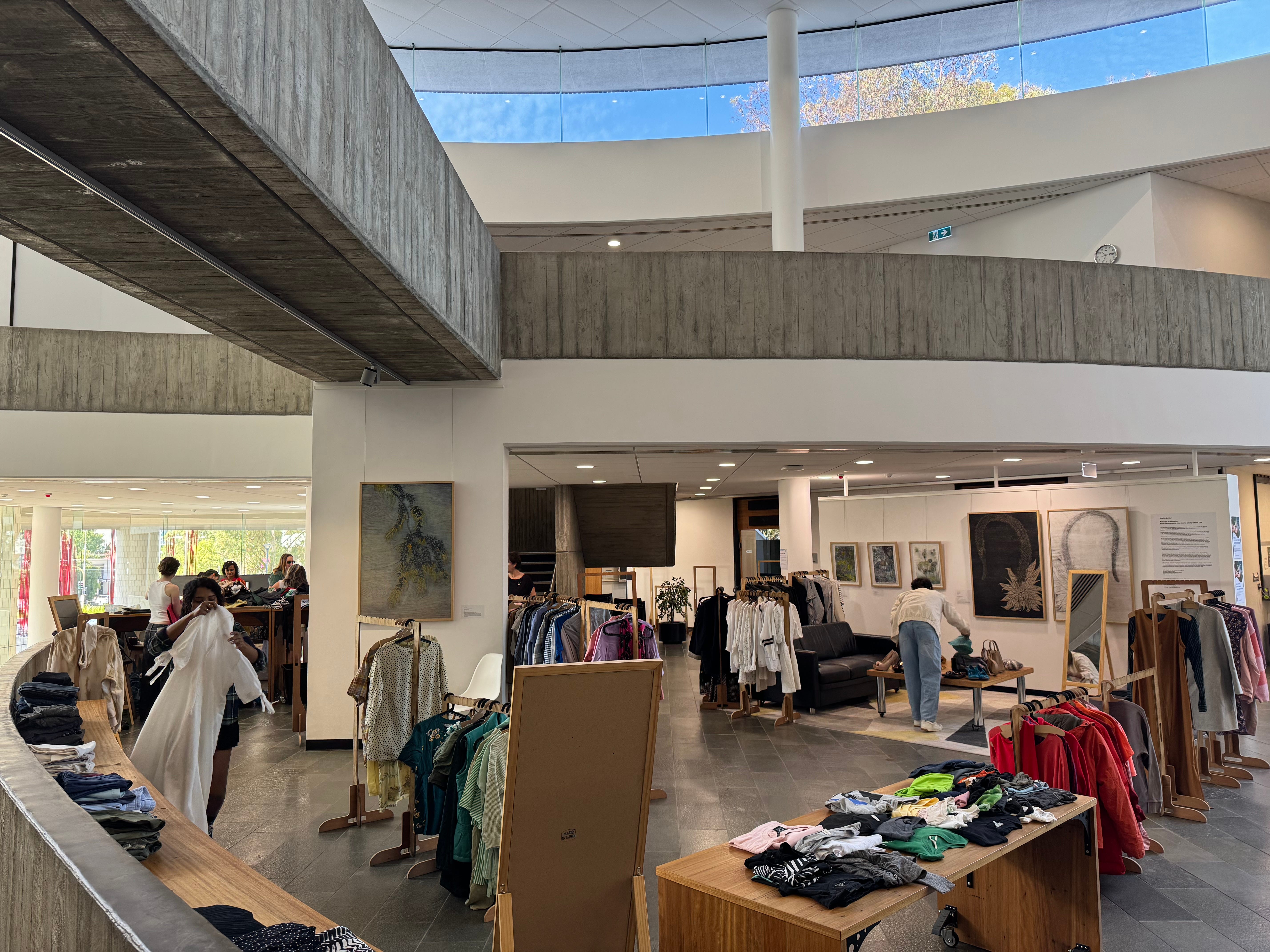
When The Monash Herald visited the Great Exchange on the 15th, walking into the Monash Civic Centre felt like stepping into a carefully curated boutique. Racks were colour‑coded, garments hung neatly on coordinated hangers, and every section was arranged into clear categories. For an event built entirely around exchanging rather than purchasing, the presentation was strikingly professional.
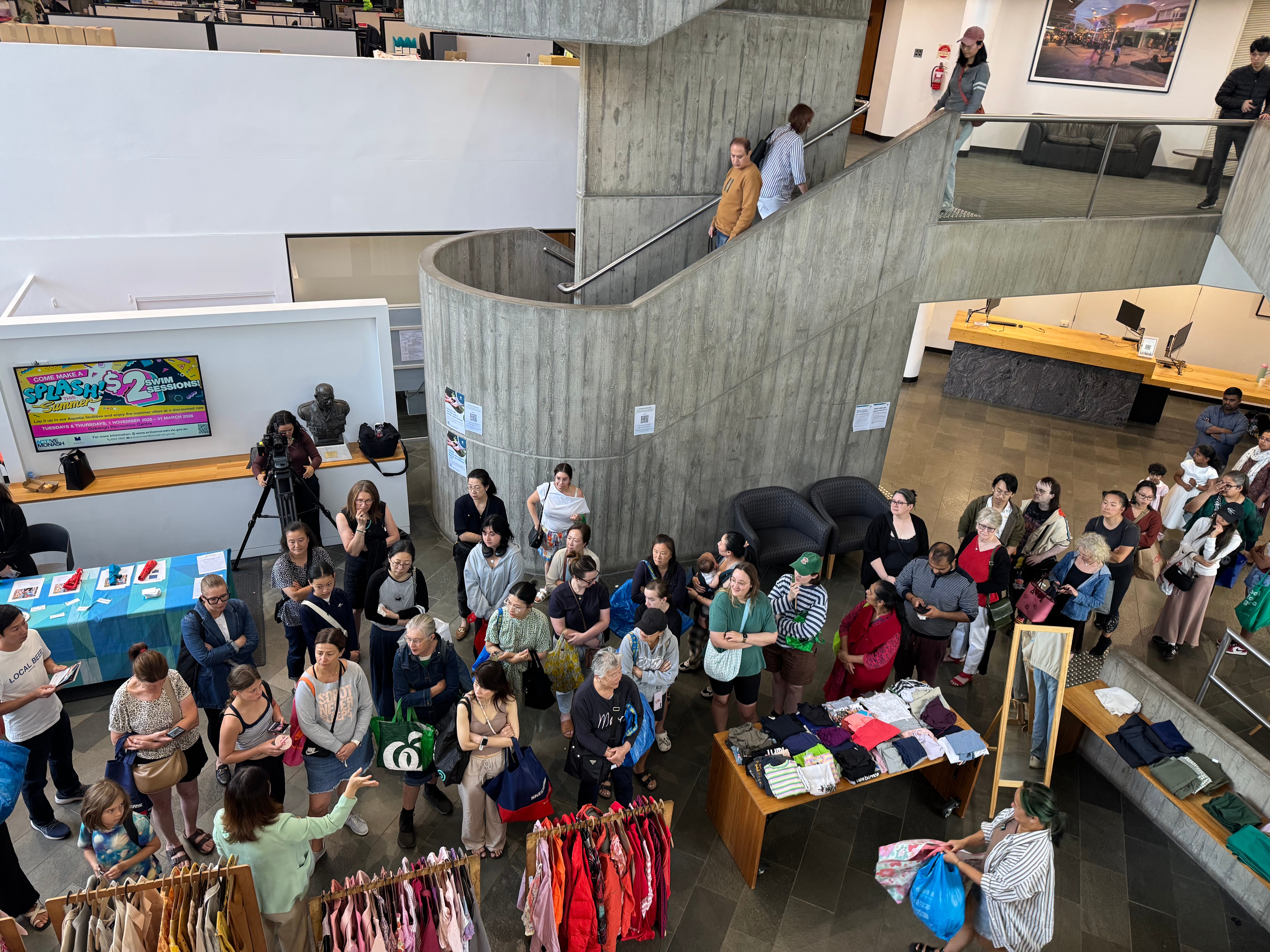
This year’s exchange, only the third since the program began two years earlier, had sold out well in advance. More than 250 adult tickets had been claimed, along with around 100 children’s tickets. Admission was free.
Organisers had developed a system to keep the crowds moving. Teen and adult clothing occupied the ground floor, while the upstairs level was dedicated to newborns through to roughly 10‑year‑olds. The children’s section was run entirely by council staff, while the Clothing Exchange, a social enterprise focused on sustainable fashion, managed the adult floor.
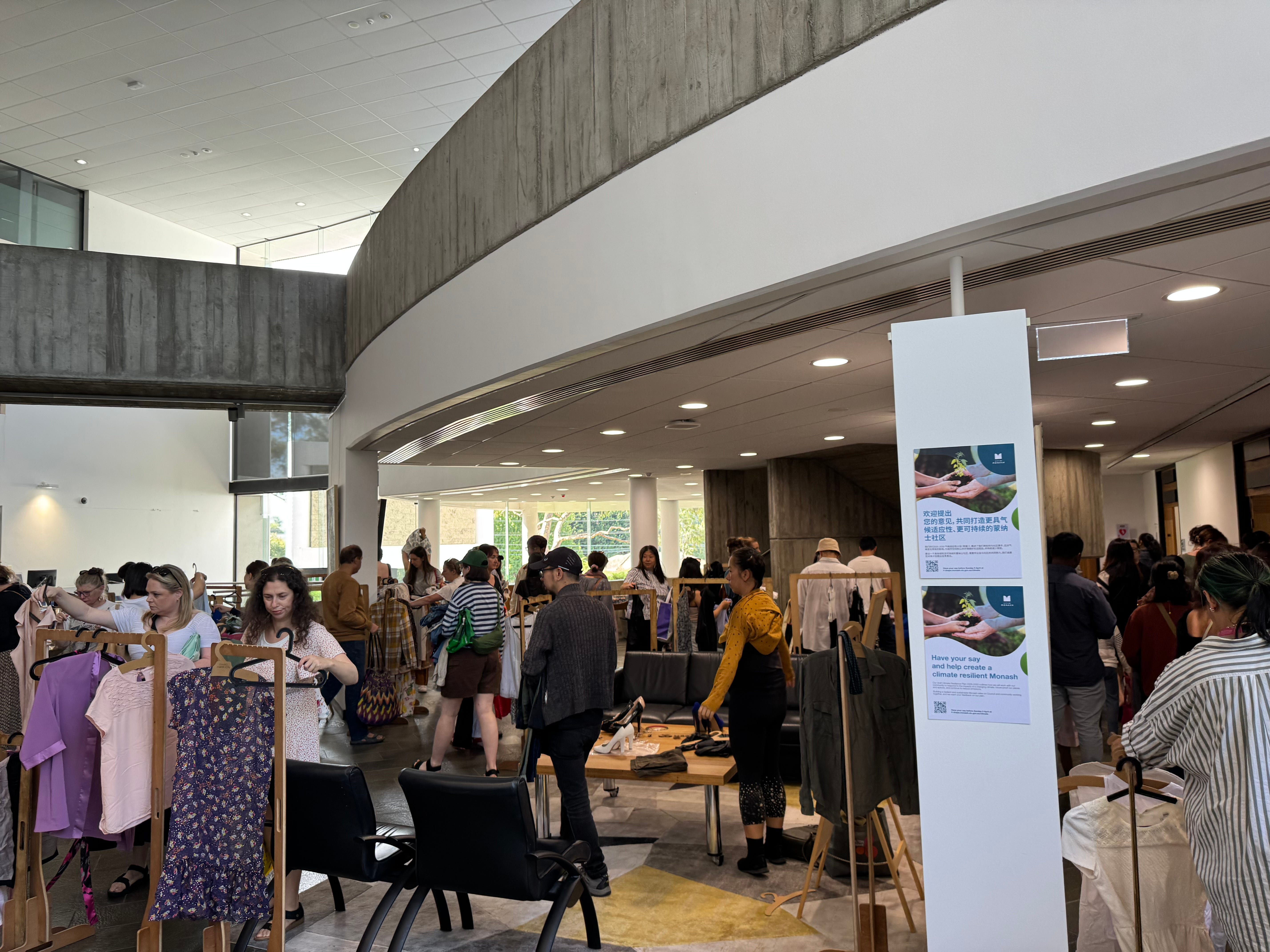
One of the volunteers with the Clothing Exchange, Shiangi, said she had been helping at swaps for about six months. “I’ve done about five swaps now,” she said, sorting garments into labelled tubs. “We do almost one every month.”
She was buoyed by the turnout. “I think it’s great. We had a lot of clothes for the swap,” she said. “The last one we did was in a regional area and there weren’t a lot of people, so this is a great turnout.”
New garments are commonplace, she said. “Some still have tags — they’ve never been worn. A lot of what we see is perfectly good clothing that just didn’t fit the buyer.”
Even so, the swap holds to strict standards.“We don’t take undergarments, swimsuits, children’s wear or athleisure,” she explained. “It’s mostly for hygiene reasons. And nothing with missing buttons or broken zippers. We have a mending circle that takes care of those kinds of clothes before they come to the swap, but we still don’t take anything with stains.”
The scale of the event surprised even seasoned volunteers. “It’s massive,” she said. “It was 250 people, and then on top of that about 50 to 70 on the waitlist.”
The popularity was obvious the moment the doors opened. Within minutes, the space filled with families, students and seasoned swappers combing through the racks for their next find. Demand had grown so quickly that organisers said they were now running three exchanges a year, two full‑scale Great Exchanges like this one, and a dedicated children’s event.
The Monash Herald asked a few locals what drew them to the event. Tracy, who was juggling a handful of tiny T‑shirts, said she had come mainly for the children’s section. “I really mainly came for the kids’ clothing,” she said. “I just finished from there and I got some new ones.”
For her, the appeal was partly practical, partly financial. “It just makes it easier,” she said. “Cost‑of‑living‑wise, yeah, but also it’s easier than selling it yourself. You come to one place and everything’s here.”
With young children who outgrow outfits almost as quickly as they acquire them, she said the swap solved a big dilemma. “Kids grow out of clothes — what can you do with them after? People sell them everywhere else, but here you don’t have to worry about that. You don’t have to sell it yourself. In that sense, it’s easier.”
Another local, Janne, was hard to miss. Her bright jacket and green Converse, both second‑hand finds, matched the cheerful chaos of the room. “I love op‑shopping,” she said. “I do it every week.”
She’d planned to come last year but was sick on the day. “So when I saw it was back, I thought, great; it’s a way to exchange things instead of sending them to landfill.”
Janne has her regular circuit of shops. “I’ve got a bunch of little op shops I go to,” she said. “There’s one in Bayswater, Forest Hill is actually quite good, and the Salvos near me; I’m in there all the time. I usually pick up something each week.”
That regularity comes with rules. “It’s very hard in Australia because I go, okay, I need this and I need that and I need more,” she laughed. “So with clothing, for everything I buy, I have to take something out of my wardrobe. When I get something, I make sure something goes back.”
If Monash’s Great Clothing Exchange demonstrates anything, it’s this:
Australia’s textile waste crisis is vast, and no single swap event will reverse decades of overconsumption. But the Great Clothing Exchange shows what’s possible when councils, volunteers and residents pull in the same direction. If nothing else, it proves that the appetite for alternatives is already here.