

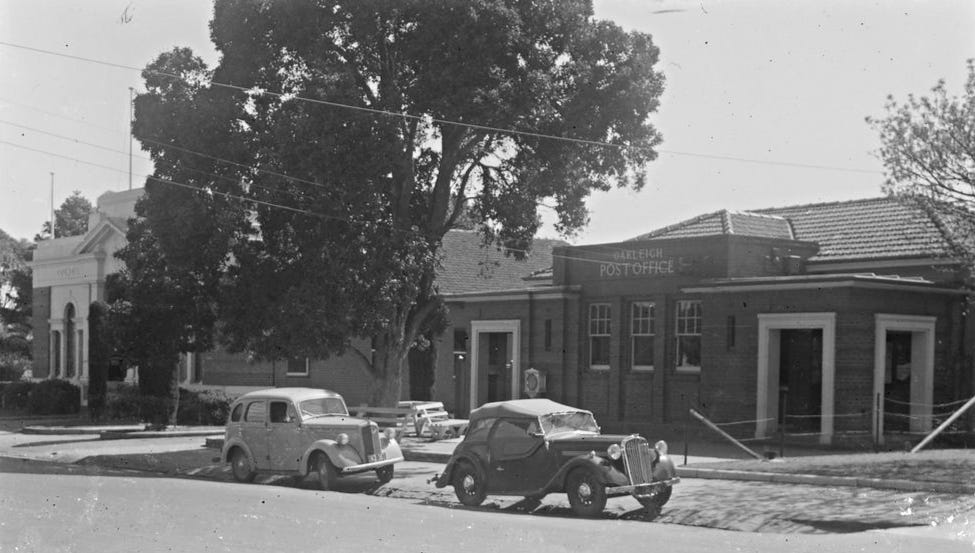
Oakleigh Post Office & Council Chambers, Atherton Road, Oakleigh, photograph, c. 1954, State Library of Victoria
There was a time when a trip down some streets in Clayton required less driving skill and more blind faith.
After heavy rain, cars disappeared axle-deep into mud. Children arrived at school with clay caked to their shoes and socks. Residents kept timber planks by their front gates to navigate the bog that lay between their homes and the nearest passable road. In one oft-repeated local story, a pregnant woman had to be carried through the sludge to reach a doctor.
These were Melbourne’s “Heartbreak Streets”.
The name carried none of the menace associated with urban decline. There was little crime and few of the social problems that would later come to define disadvantaged suburbs. The heartbreak was simpler than that. Families had invested their savings, their hopes and their futures in a suburban dream that seemed permanently out of reach.
In the years after World War II, Melbourne was growing faster than its infrastructure. Thousands of returned servicemen, migrants and young families were searching for somewhere to live. The city’s south-eastern fringe offered an answer. Land in Oakleigh and Clayton was affordable, available and close enough to employment opportunities to appear an attractive proposition.
What those new residents discovered was that a housing estate and a functioning suburb were not the same thing.
Much of the district had been shaped by clay extraction, sand mining and brickmaking. When developers moved in, they subdivided former farmland and quarry land at remarkable speed. Blocks sold quickly. Houses followed. The roads, drains and footpaths did not.
Winter transformed unsealed streets into quagmires. Summer brought dust storms that swept through half-built estates. Drainage was rudimentary or non-existent. Public transport lagged behind population growth. Residents found themselves living on what felt like a frontier settlement.
The population boom of the early 1950s only intensified the problem. New families arrived every month, but local councils lacked the resources to provide the infrastructure needed to support them.
Frustration grew.
Then something important happened.
The residents who had come to these suburbs in search of opportunity began organising. Progress associations sprang up across the district. Meetings were held in scout halls, church rooms, lounge rooms and unfinished garages. Neighbours who had little experience in politics learned the mechanics of advocacy. They wrote letters, organised petitions, confronted councillors and lobbied state governments.
Their demands were hardly radical; they wanted roads that could be driven on, footpaths that could be walked on and drains that carried water away from their homes.
Yet those modest demands would help reshape local government in Melbourne’s south-east.
Research by historian Dr Andrew Foley has highlighted the extent to which these grassroots campaigns changed the trajectory of the district. Resident pressure forced councils to accelerate infrastructure programs and prompted greater scrutiny of subdivision practices by state planning authorities. What began as local complaints evolved into a broader challenge to the way Melbourne was managing suburban growth.
The significance of that activism can still be seen today.
The City of Monash is now one of Melbourne’s most important economic and educational centres. The Clayton campus of Monash University has become a globally recognised hub of research and innovation. Major employment precincts stretch across the municipality. Its streets are lined with thriving businesses, diverse communities and the infrastructure that earlier generations fought so hard to secure.
The transformation is so complete that it can be difficult to imagine the landscape that preceded it.
The roads are sealed. The drains are underground. The mud has long since disappeared beneath asphalt and concrete.
But the story of the Heartbreak Streets feels strikingly contemporary.
Melbourne is again grappling with the consequences of rapid growth. New housing estates continue to emerge on the city’s fringes, often accompanied by familiar debates about transport, schools, roads and community infrastructure. The central question remains unchanged: what happens when development outpaces the services that make a community function?
The residents of Oakleigh and Clayton understood the answer decades ago.
They built homes in difficult conditions and raised families in suburbs that often seemed forgotten by decision-makers. More importantly, they refused to accept that neglect was inevitable. Through persistence and collective action, they transformed not only their streets but the expectations of what suburban life in Melbourne should be.
Their legacy survives in places that no longer resemble the Heartbreak Streets at all.